This class was amazingly beneficial to me. It allowed me to learn how to actually write a paper in a way that had really never been broken down for me before, and showed me a lot of things that I really needed to learn how to do properly, as well as letting me see what I was already good at. Previous to this class, my abilities to really break down and analyze something were close to nonexistent, and while they are definitely still in need of a lot of work, I have seen an infinite improvement in the way I approach the task of "writing a paper." I have learned how to really divide up my tasks and put an equal effort into every aspect, rather than rather hurriedly trying to shove as much into words as I could, and subsequently losing a lot of meaning and depth in my writing.
While it may not be evident to an outside reader, writing this post really caused a breakthrough for me in terms of creating a solid thesis. Before this specific assignment, I really was at a loss when it came to this basic skill, because I really didn't understand the mechanics of a "thesis." This assignment really forced me to teach myself how to break down an idea and then rebuild it in an exact pattern.
Another assignment that really sparked me was this one. The entire process that we worked through with our W;t essays really had an impact on me. I have to say, this may be one of the very first, proper rough drafts I had ever written in my life. And this is from someone who really, really loves to write. I literally didn't know how to write a draft. This was honestly a huge impact on the way I think about writing papers. It was actually kind of incredible.
Receiving feedback from fellow students as well as our instructor was, while at first a little strange, actually very helpful. It allowed me to see a lot of random perspectives, rather than a single person's. Also, it seemed that every comment had a different suggestion or compliment than the previous one, which helped me to see smaller aspects of my writing that were or were not helping my overall goal.
All in all, I enjoyed this class immensely. I know that I am not supposed to gush too much in my writing (sorry, professor Burton), but this is a response, not an analysis. This is possibly the most useful class, as far as my writing is concerned, that I have ever taken.
Showing posts with label posted by Veronica Whelan. Show all posts
Showing posts with label posted by Veronica Whelan. Show all posts
Monday, April 18, 2016

Wednesday, March 23, 2016
Next Steps and Draft: Sylvie and Bruno~
Okay! So during my discussion with Justin in class, I came to the conclusion that I had a pretty good thesis for what I'm going for, and got even more excited about some sources I had been previously been dubious about. I realized that some of them, while I saw them as "far-fetched," may actually be really useful as clever counterarguments. Also, after talking to Justin about varied sources, I was even happier about a specific source on Lewis Carroll and Alice in Wonderland that I had found. I decided that the next bit I would work on would be outlining and drafting, like we did with our W;t essays, and so I was pretty grateful that we were actually assigned to do so. I have never really been very good at drafting in the past, but really loved how it worked out for me when I did it properly. Overall, I am actually kind of excited about this! Is that nerdy? Yes...that's nerdy.
Sunday, March 20, 2016
Sources for Sylvie and Bruno!
All right, here we go. Source compiling...start!
Working thesis statement: Lewis Carroll, in his novel Sylvie and Bruno, makes the statement that although children may be seen as "innocent" and adults "guilty," there must be a bridge between these two places in order to achieve an ideal balance between purity and knowledge.
Working thesis statement: Lewis Carroll, in his novel Sylvie and Bruno, makes the statement that although children may be seen as "innocent" and adults "guilty," there must be a bridge between these two places in order to achieve an ideal balance between purity and knowledge.
Monday, March 14, 2016
Playing with Sylvie and Bruno
"There's nothing a well-regulated child hates so much as regularity. I believe a really healthy boy would thoroughly enjoy Greek Grammar - if only he might stand on his head to learn it!"
Monday, March 7, 2016
Sylvie and Bruno
So, for my paper, I have decided to write about a lesser-known novel by Lewis Carroll entitled Sylvie and Bruno. A good deal of people professing to be Lewis Carroll "fans" have only read his most basic works (the Alice stories, for example, or The Hunting of the Snark) but have not even heard of this novel, as well as its successor, Sylvie and Bruno Concluded. While these stories maintain the absurdity that his more famous works are known for, they also add in a factor of very interesting, and rather well-presented themes. Overall, this work is remarkably underrepresented.
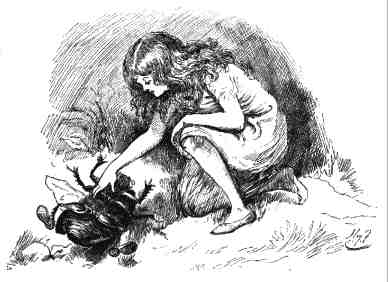 |
| "Sylvie...had knelt down, just as I was doing, and was trying to help the Beetle..." |
Friday, February 26, 2016
Library Time!
Ah! So, which much ado, I have finally collected all of the sources I will be using in expanding my essay. I decided to end up using two of Kayla's provided resources, including one that I (sadly) am not allowed to leave the library with without getting arrested. All is well! I shall take meticulous notes from it before I leave.
In other words, I believe I have met all of the requirements for the research. I will be using W;t itself as a reference, the film dictionary that I am not allowed to steal, an eBook on film adaptations, and two journal articles, one dated this year, I believe, and another dated 1987.
All in all, I think I have found some good sources to expand my work with! Some of them I did get pretty excited about. Again, thank you Kayla! Great help!
In other words, I believe I have met all of the requirements for the research. I will be using W;t itself as a reference, the film dictionary that I am not allowed to steal, an eBook on film adaptations, and two journal articles, one dated this year, I believe, and another dated 1987.
All in all, I think I have found some good sources to expand my work with! Some of them I did get pretty excited about. Again, thank you Kayla! Great help!
Sunday, February 21, 2016
Some Resources for Sage!
All of these were found in the HBLL databases! (Also, I couldn't figure out how to get hanging lines on here, so the second lines of these citations are just spaced out. If you use any of them you might need to fix that--I just wanted them to look right here. And one more thing. I tried to make sure all of these are actually available, but some might only be in print format from the library itself. I'm not completely sure. So I apologize in advance if anything is inconvenient.)
Wednesday, February 17, 2016
More W;t (Essay)
(I finished my editing, and then felt highly self conscious that my essay was shorter than everyone else's. Silly, I know. So I decided to take my remaining ten or so minutes and beef it up a bit, but at the same time, I'm afraid of over-talking and ruining my point. So.)
Viewing the play W;t as a film is an experience which allows the viewer to be exposed to a good deal of ideas and notions that may, in its stage format, be missed. W;t embodies a plethora of emotion and emotional tension that is best explored very close to the characters, Watching W't as a film urges a deeper comprehension of the story by exhibiting a visual representation of the characters' interactions, rather than forcing viewers to infer subtly (or miss entirely) through a viewing of the play from a distant stage.
Viewing the play W;t as a film is an experience which allows the viewer to be exposed to a good deal of ideas and notions that may, in its stage format, be missed. W;t embodies a plethora of emotion and emotional tension that is best explored very close to the characters, Watching W't as a film urges a deeper comprehension of the story by exhibiting a visual representation of the characters' interactions, rather than forcing viewers to infer subtly (or miss entirely) through a viewing of the play from a distant stage.
Friday, February 12, 2016
Watching W;t
1) Narrator. W;t's entire texture depends greatly upon its style of narration, and the idea of "breaking the fourth wall". The film used this aspect well, showing Vivian speaking directly to the audience (whereas, when simply reading the play, it could possibly be interpreted as her narrating to no one in particular.)
Tuesday, February 2, 2016
We All Know Shakespeare Loved a Good Song (And Probably a Good Thesis)
For my thesis re-writing, I chose the essay titled "A 'Most Happy Wrack': Achieving Musical Harmony in Twelfth Night".
Original: The writer of this essay places their thesis rather straightforwardly as the opening statement. It reads, "Shakespeare’s clever use and knowledge of music is one of the things that distinguishes his plays from his contemporaries." This seems to be a sort of causal claim. However, the following sentences in the paragraph seem to be much more specific, and make one guess if the original claim should perhaps be narrowed down in order to be believable.
Edited: "Shakespeare's knowledge and use of music and musical references in Twelfth Night is one thing that helps to set apart this play from many other contemporary plays." This claim, also causal, takes the exact same idea, applies it more specifically to what the essay is actually about, and becomes both more believable and more interesting.
Original: The writer of this essay places their thesis rather straightforwardly as the opening statement. It reads, "Shakespeare’s clever use and knowledge of music is one of the things that distinguishes his plays from his contemporaries." This seems to be a sort of causal claim. However, the following sentences in the paragraph seem to be much more specific, and make one guess if the original claim should perhaps be narrowed down in order to be believable.
Edited: "Shakespeare's knowledge and use of music and musical references in Twelfth Night is one thing that helps to set apart this play from many other contemporary plays." This claim, also causal, takes the exact same idea, applies it more specifically to what the essay is actually about, and becomes both more believable and more interesting.
Sunday, January 31, 2016
Staking a Claim
Well, this is a bit of an exercise. We'll see how I fair. It's a little up in the air at the moment. Wish me luck! Constructive criticism is thoroughly welcome, as this is not my strongest area of writing! (My strongest, sadly, is rather unusable in most scenarios.) I've chosen to sort of stick to the topic of education and knowledge in these, just exploring the same kind of idea using the different types of claims we learned about.
Wednesday, January 27, 2016
W;t's Wit.
Personally, I found Edson's W;t to be a very interesting and clever way to capture a character in a manner that is not, perhaps, as dark as it could have been made to be. The synopsis located on the back cover of the book describes the protagonist of the story as "intensely rational", which I too find to be an apt phrase to use. I will, however, point out a few details on form that interested me. (I tried very hard to back down on my gushy tendencies in this post.)
Monday, January 18, 2016
Writing Plan and Record: Veronica Whelan
I'll start off by warning everyone that I've had a migraine off and on for that past 24 hours, but I can't put this off any longer...so if my writing is completely disjointed or complete gibberish, I am dreadfully sorry. Feel free to tell me I don't know what I'm talking about, because at this point, odds are I might not.
Wednesday, January 13, 2016
We're Not Done Here
A Preliminary Formal Analysis of John Donne's "A Valediction: Forbidding Mourning"
1. Genre. This is a poem of the lyric genre, and therefore shows the emotions and affections of an individual speaker, much like a song. The focus remains on the speaker’s thoughts for the duration of the poem, and is very personally emotional:
1. Genre. This is a poem of the lyric genre, and therefore shows the emotions and affections of an individual speaker, much like a song. The focus remains on the speaker’s thoughts for the duration of the poem, and is very personally emotional:
Such wilt thou be to me, who must
Like th’other foot, obliquely runne;
Thy firmness drawes my circle just,
And makes me end, where I begunne.
Sunday, January 10, 2016
She's the Type to Cry When the Villain Dies
Veronica is a thoroughly emotional writer, in every sense of
the term—she writes in a way that conveys not only her own emotions towards the text about which she is writing,
but also what emotion it is that the text itself
portrays. Emotion seems to be what speaks to her, particularly the portrayal of
emotion in literature. One of her more recently written abstracts (written for
an essay which she says that she does, at one point, hope to finish) was based
fully on Jane Austen’s sense of the “androgynous mind” and “human” emotion
versus “male” and “female” emotion. This sense of writing, however, while it
can be rather insightful and humanizing, can also cause the writer to lack
somewhat appallingly in other even basic areas.
Tuesday, January 5, 2016
Realer Friends Than My Real Friends
When I was at the age of five, my mother read to me The
Chronicles of Narnia. She'd been reading books to me since before I was born,
yes, but there was something slight and undefinable about this particular
series that was enough to ignite in me a constant need for a story. My younger
sister and I had hugely vivid imaginations, and would act out scenes from Narnia in our back yard, usually
resulting in a fight over who got to be Lucy. She was a favorite, for whatever
exact reason.
My mother read dozens of stories to me at that age and
older, even—I remember she read to me Understood
Betsy when I was around ten years old. I learned several stories this way,
including Alice’s Adventures in
Wonderland (which sparked a rather deep love for Lewis Carrol in me), and
children’s versions of plays by Shakespeare.
As I grew older, this stuck with me. I found myself daydreaming
about a character’s world rather than my own. How I would prefer it, or how
well I would live alongside those characters. I was going to marry Artemis Fowl. When I first had the
opportunity to visit Oxford at the age of fourteen, I felt that my joy could
only be completed if it was indeed Inspector Morse’s Oxford, or the Oxford
belonging to The Northern Lights’
Lyra.
Subscribe to:
Posts (Atom)